English
Staff Directory
Moore, Kristin
Dept. Lead, English 12, AP Literature
Beary, Kathryn
English 8, Journalism, MS English Support
Nowzari, Shayan
English 8, English 10
Pasquinelli, Angela
English 11, AP Language, HS English Support
Voss, Edward
English 7, English 9
Wall, Jessica
English 9, AP Literature
Mission
The UPA English Department is dedicated to broadening and deepening students’ understanding of literature as a means of exploring themselves, others, and the world around them. Through critical reading, thoughtful discussion, and analytical inquiry, we cultivate curiosity, strengthen intellectual independence, and inspire a lifelong love of learning. We also equip students with the writing and speaking skills necessary to communicate effectively, express their ideas with confidence, and succeed in college, careers, and civic life.
Vision
The UPA English Department envisions a community of engaged readers, thoughtful thinkers, and confident communicators who use literature and language to better understand the human experience. We strive to empower students to think critically, write persuasively, speak purposefully, and approach the world with curiosity, empathy, and a commitment to lifelong learning.
Overview
UPA’s English Department goal is to broaden and deepen students’ understanding of literature so that they may develop curiosity about themselves and society, deepen their analytical skills, and become lifelong learners. We also seek to give students the tools to express their ideas through writing and speaking to empower them in college and beyond.
Courses
-
English 7 Learning Objectives
Students will…
Practice respect, honesty, integrity, and accountability both within and outside the classroom
Demonstrate command of the conventions of standard English grammar and usage when writing or speaking.
Choose a language that expresses ideas precisely and concisely, recognizing and eliminating wordiness and redundancy.
Expand academic vocabulary using common, grade-appropriate Greek or Latin affixes and roots to improve their reading, writing, and speaking, and identify word meaning in context
Document their work using appropriate conventions (MLA)
Course Texts
Summer Reading: Hatchet, Esperanza Rising | Semester 1: The Outsiders | Semester 2: The Giver
Other Info
Casual Assessments – 30% | Formative Assessments – 40%
Major Assessments – 22% | Final Assessments – 8%
-
English 8 Learning Goals:
Students will improve as writers in terms of content, integrating evidence, and the language used to convey their message.
Students will have opportunities to engage with and critically analyze meaningful texts while improving their skills in critical thinking.
Students will improve their writing organization by strengthening their grasp of paragraph structures, MLA citation, and new forms of writing.
Students will come to love at least one book/project/activity from this class.
Course Texts:
Fever 1793 by Laurie Halse Anderson | Animal Farm by George Orwell | House on Mango Street by Sandra Cisneros | And Then There Were None by Agatha Christie | Me Moth by Amber McBride
Grade Breakdown:
40% Formative Assignments: quizzes, homework, class work, and vocabulary work (feedback will sometimes be given)
30% Casual Assignments: graded for completion (no feedback given)
22% Major Assignments: essays, projects, the final (feedback will always be given)
8% Final: Last major assignment of the semester (1-2 page Vignette in S1, Portfolio in S2)
Typical Homework:
Students are assigned around 20 pages of reading from their assigned book each class and expected to fill out a reading log in the process.
Students are consistently provided in-class time for projects, but may on occasion require more time to finish it at home.
Summer Reading:
Books are provided by the school at the end of the school year. Students are expected to read the book with attention to plot and theme before the start of 8th grade. Audiobook and PDF of the book are also linked on the school website for those who need it!
-
English 9 Learning Goals:
Read for Understanding:You read the assigned class texts and come to class prepared to discuss with peers. You read closely to understand texts and develop original interpretations supported by evidence.
Speak and Listen: You use small-group and whole-class conversation opportunities to listen, hone your own ideas, and have a meaningful impact on the thinking of others.
Write: You write narratives, arguments, and informative pieces to think through life and impact your readers. You demonstrate command of the conventions of English (spelling, word choice, grammar).
Revise Intentionally: You revise extensively to improve a piece of writing
Course Texts:
Summer reading: student choice, The Hate U Give, Cambodian Rock Band, “Healing Rosa”, Romeo and Juliet
Amount of homework per night: No more than 30 min of work will be assigned each night. This homework will usually be reading and/or reviewing key terms for the class.
Summer Homework: You are expected to read one book of your choice in the fantasy or sci-fi genre, at least 200 pages.
-
World literature core values:
Why is it important to engage with diverse stories?
"The Danger of a Single Story"
Windows and mirrors
Improve reading and critical thinking skills through reading complex texts
Build upon skills from 9th grade to prepare for college-level writing and discussions
World literature units:
Personal narratives (Funny in Farsi)
Character analysis (Things Fall Apart and other literature from African writers)
Artists’ choices & intentions: (short form literature, primarily from Latin American and Indigenous writers)
Multimedia analysis: WWII narratives (Maus, Night, They Called Us Enemy, Jojo Rabbit)
Perspectives and rhetoric (Before the Coffee Gets Cold)
Etc.
Course Texts:
Funny in Farsi | Things Fall Apart | Maus | Night | Before the Coffee Gets Cold
We also engage with poems, short stories, songs, and films from all over the world (i.e., Eritrea, Latin America, Indigenous tribes, etc.)
Homework: In world literature, most assignments are done in class and collected at the end of the period. However, there may be times when students may need to finish the assigned reading and/or work on summative projects outside of class.
Summer homework: Students are expected to read Funny in Farsi over the summer. While reading, students should focus on the themes of identity, cultural assimilation, and family. Questions to consider while reading:
How does Dumas illustrate the joys and challenges of balancing her Iranian heritage with her American life?
How does Dumas portray the role of family and community in shaping her experiences and perspective?
How do her interactions with family members and others contribute to her sense of belonging and/or isolation
-
Course Overview (subject to change)
Unit 1: Voice in Verse — How do people use language to express their identity? How am I shaped by my background?
Unit 2: American Identity — What does it mean to be American? To what extent is the American Dream achievable for all people? How can I effectively synthesize multiple sources to prove the same argument?
Unit 3: Family — To what extent are people shaped by their family? Which is more influential: family or friends?
Unit 4: Past, Present, Future — How do people’s past experiences shape their goals for their future? What is literary criticism, and how can I incorporate it into my own analysis?
Unit 5: Lit Circles — How are individuals shaped but not bound by their background? How can I apply what I’ve learned this school year to analyze new texts and collaborate with my classmates?
Course Texts:
Summer Reading: Poet X | Semester 1: Raisin in the Sun | Semester 2: The Great Gatsby
Who can take this course? Any UPA junior
Amount of homework per night: 1st semester usually none, 2nd semester reading 10-20 pages per class
Summer homework: Read The Poet X
Link to syllabus
-
The purpose of AP Literature and Composition is to:
Teach deep, critical reading and writing skills through analyzing complex novels, plays, and poems, and writing essays.
Build an understanding of the human experience through literature.
Foster independent thinking.
Prepare students for college-level classes and the AP Literature exam.
Course Texts:
The Glass Menagerie | The Catcher in the Rye | The Kite Runner | The Great Gatsby | Fahrenheit 451 | The Poet X
We also read a variety of poems throughout the year.
Who can take this course? Any junior with a B or higher in both semesters of their English 10 class.
Amount of homework per night: It varies, but count on spending about an hour of homework time before each class meeting.
Summer Homework: You are expected to read three books over the summer and complete a short handout on each.
-
What students will get out of the class:
Develop critical thinking and writing skills.
Learn the elements of film and film criticism.
Appreciate how the film can connect us as a society.
Textbook: The Art of Watching Films by Petrie and Boggs
Films:
Sunset Boulevard | The Gold Rush | It Happened One Night | Citizen Kane | Vertigo | Imitation of Life | Psycho | Night of the Living Dead | Parasite
Who can take this course? Any UPA senior.
Amount of homework per night: I try to keep the homework to a minimum, but on average, you will have about an hour or two of homework per week.
No summer homework.
In the second semester, students either conduct a research project on any film subject of their choosing OR make a short film (five minutes maximum).
-
This course focuses on the study of how people communicate and is designed to prepare students for future college classes as well as the AP Lang exam in May. During the year, students analyze primarily nonfiction texts with a focus on rhetoric, argument, and synthesis. Additionally, students will develop their own personal narrative writing as they apply for college.
Course Texts:
Choice between Born a Crime and The Glass Castle
Who can take this course? Any UPA senior who earned a B or higher in both semesters of their 11th-grade English class
Amount of homework per night: Usually none
Summer homework: Read either Born a Crime or The Glass Castle
-
What We Do:
Students in the journalism class serve as the staff for the student news publication Aquila, both in print form (newsmagazine) and online at upaaquila.org.
Units of Study:
Photojournalism
The art of the interview
Types of writing (news, feature, profile, in-depth, arts & culture, editorials)
Layout & graphic design
Principles of journalism
& role of a journalistMedia law
Media ethics
Modern media issues & media literacy
Course Texts:
Journalism: Publishing Across Media (online PDF textbook)
SPJ Code of Ethics + Aquila Code of Ethics
Outside of Class Commitments:
Reporting!
Interviews
Research
Writing
Editorial Board Meetings
Production night (1x issue = 3x year)
Typically: W (4:00pm- 5:30pm), TH (3:30pm- 6:30pm)
Students make final edits to their articles and provide feedback/assistance to others before the newsmagazine is sent off to print, and online articles are prepped to be published!
How can students be successful?
Completing work to its fullest + be a self-starter!
Meeting deadlines to ensure a smooth editing process
Showing enthusiasm toward their work, that of others, and their commitment to the Aquila team.
Be curious! Be ready to interview, research, and ask questions!
Willing to Step Out of Their Comfort Zone (speak with new people, try new things, and don’t be afraid to share your work!)
Pathway
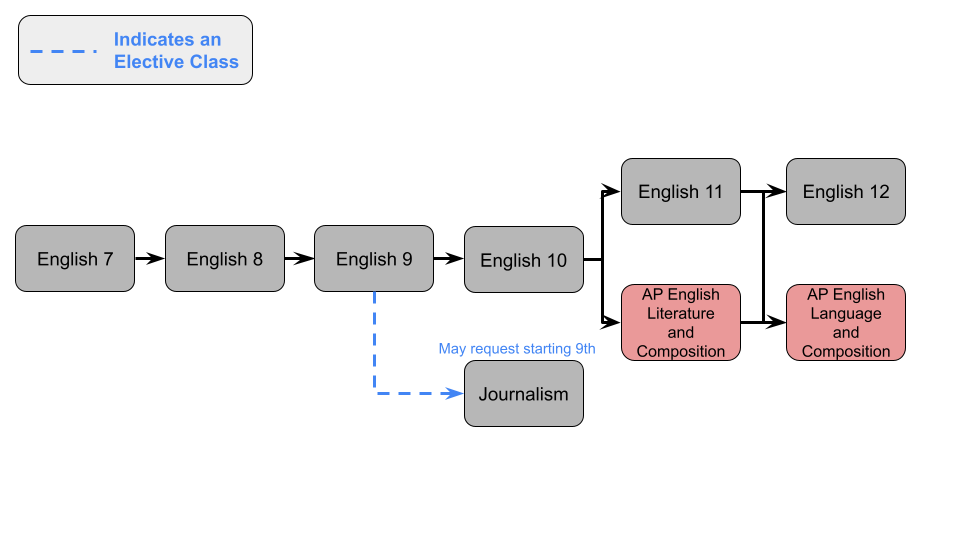
High School Graduation Requirements
Completion of would be 40 Units (4 year-long UC “b” classes)

UNIVERSITY PREPARATORY ACADEMY
2315 Canoas Garden Avenue
San Jose, CA 95125
408.723.1839